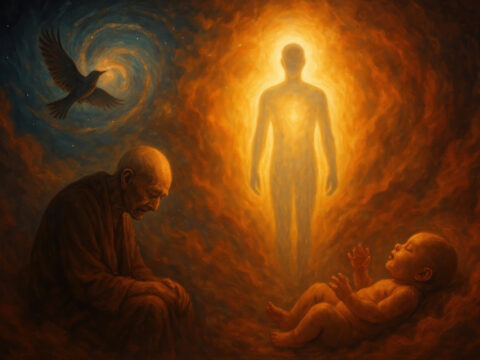
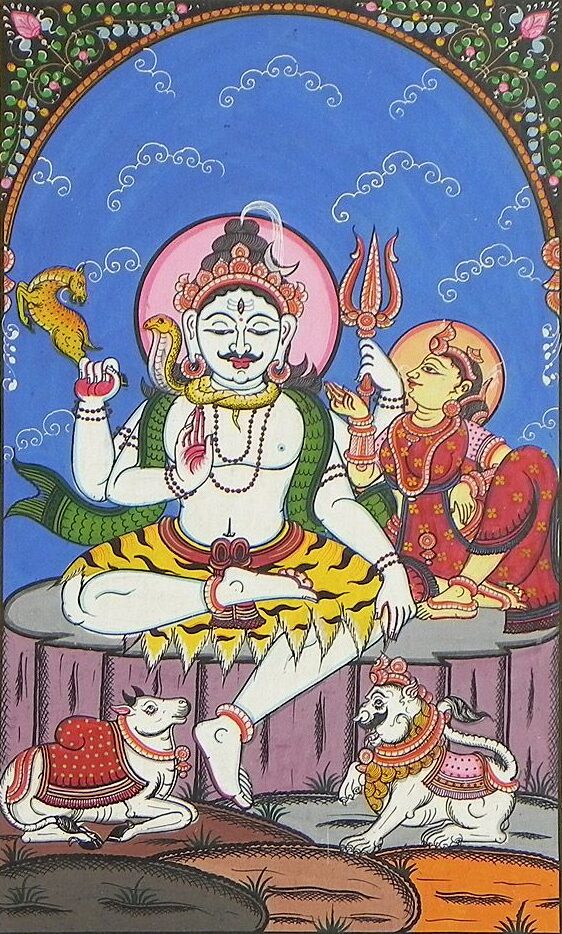
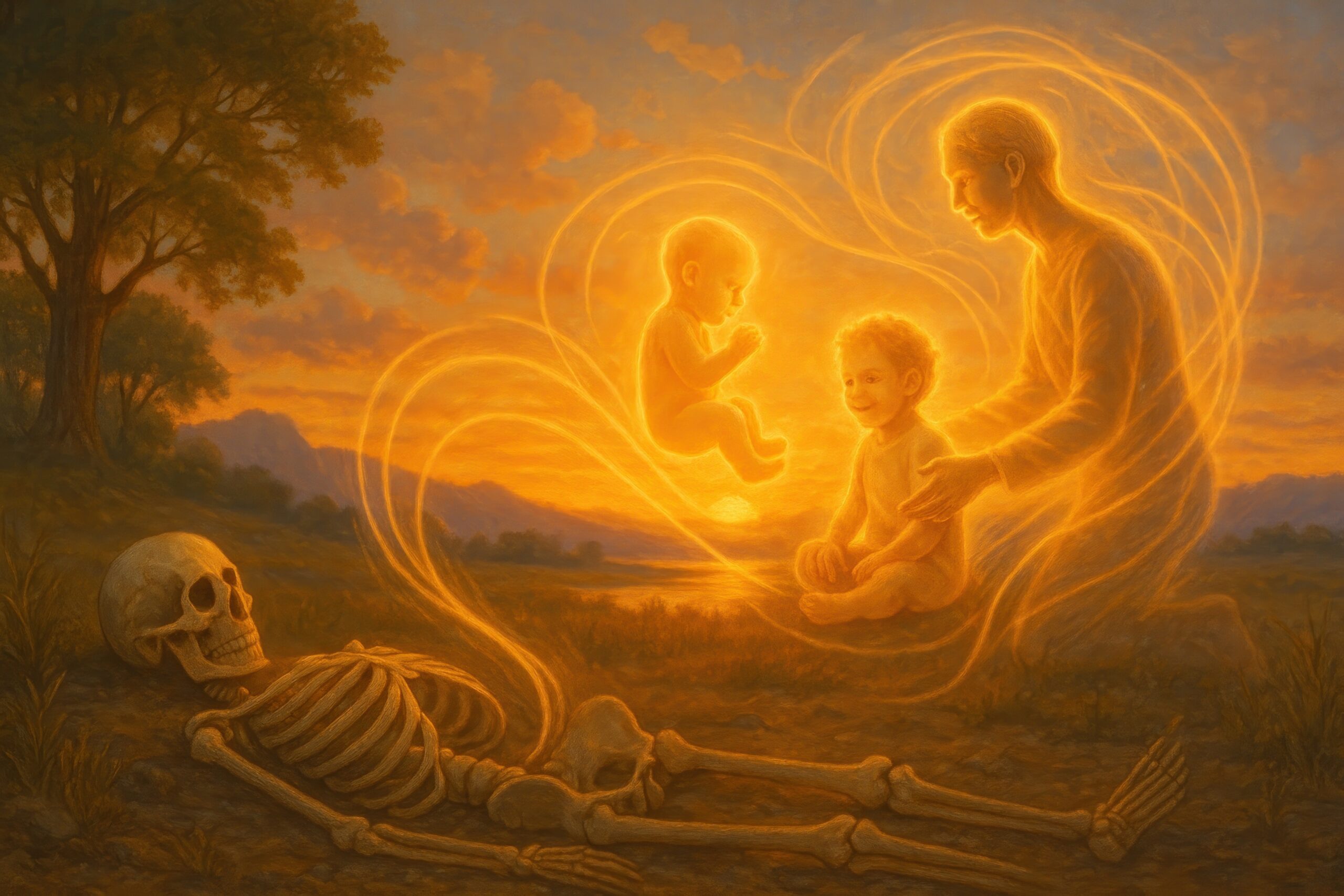
 The inner logic of Kaśmira Śaiva (Trika) is based on ① Śiva is the sole reality, ② Śakti is His dynamic self-expression, ③ and the individual self (jīva) is none other than Śiva veiled by His own freedom (svātantrya). Reincarnation, in this view, is not a mystery of souls migrating, but a play of consciousness contracting and expanding within its own infinite luminosity.
Within the Trika vision of Kaśmira Śaiva, the phenomenon of rebirth is not an extraordinary event but a natural movement within the pulsation of Consciousness itself. The universe is understood as the ceaseless spanda — the subtle throb of Śiva’s awareness — and every birth, death, and re‑embodiment is simply a modulation of this single, undivided Light. Yet in modern scientific discourse, reincarnation has remained peripheral, even though several thoughtful scientists have urged that it deserves deeper attention.
Carl Sagan once acknowledged that among the claims of parapsychology, one stands out: young children who recall details of a previous life with uncanny accuracy. From a Śaiva perspective, such recollections are not anomalies but glimpses through the thinning veil of māyā, moments when the contracted self (aṇu) briefly remembers its wider continuum of experience.
Quantum Mechanics and the Śaiva View of Reality
When nineteenth‑century physics encountered phenomena that classical models could not explain, it opened the door to quantum mechanics — a field whose discoveries echo the Śaiva insight that the material world is not the ultimate substratum. Quantum theory suggests that the observer cannot be separated from the observed, a notion that resonates deeply with the Trika assertion that cit (consciousness) is the very ground of manifestation.
As T. Folger noted, the literal implications of quantum theory still provoke discomfort, for they challenge the assumption that matter is primary. Kaśmira Śaiva would say this discomfort arises because inquiry has reached the boundary where prakāśa (pure light of awareness) and vimarśa (self-reflective consciousness) become unavoidable.
Max Planck’s view that consciousness is fundamental, and Eugene Wigner’s claim that quantum mechanics cannot be formulated without reference to consciousness, align closely with the Śaiva understanding that the universe is the self-revelation of Śiva — not an external, inert mechanism.
Modern Research Through a Śaiva Lens
In contemporary times, Dr. Jim Tucker of the University of Virginia has become a leading investigator of reincarnation-like cases. His studies describe a pattern long recognized in the Śaiva tradition: children spontaneously recalling past-life experiences before the dense conditioning of the present embodiment fully settles in.
Most begin speaking of a previous existence around the age of 35 months, offering detailed accounts of events and relationships they have never encountered in this life. Their emotional intensity — longing, grief, or insistence on returning to a “former home” — reflects the persistence of saṃskāras, the subtle impressions carried across lifetimes.
Tucker notes that these memories typically fade by age six or seven. In Śaiva terms, this is the stage when the mala-bound individuality becomes more firmly contracted, and the child’s awareness becomes absorbed in the present configuration of Śiva’s play.
The Trika Interpretation
From the standpoint of Kaśmira Śaiva:
- There is no “soul” traveling from body to body.
- There is only Śiva, freely assuming countless forms through His own svātantrya.
- Reincarnation is the rhythmic unfolding of consciousness as it contracts into individuality and expands back into its own boundless nature.
- Past-life memories are simply moments when the contraction loosens and the deeper continuity of awareness shines through.
Thus, the cases documented by modern researchers do not challenge the Śaiva worldview — they quietly affirm it. They reveal that the jīva is not a finite entity but a wave in the infinite ocean of Śiva, carrying impressions across lifetimes until recognition (pratyabhijñā) dawns and the cycle of becoming is seen as the divine play it has always been.