 Within the Indian darśanas, the idea of rebirth is not an anomaly but a natural extension of how consciousness expresses itself through time. Yet in the modern scientific world, reincarnation has remained at the periphery of formal inquiry, even though several thoughtful scientists have urged that it deserves deeper study. Carl Sagan himself once acknowledged that among the claims of parapsychology, one especially merits serious attention: the reports of young children who recall details of a previous life with a precision that cannot be explained by ordinary means.
Such phenomena belong to what Indian traditions call aparā‑vidyā and parā‑vidyā — the sciences of the manifest and the sciences of the subtle. When nineteenth‑century physics encountered realities that classical models could not contain, it opened the door to quantum mechanics, a field whose discoveries echo long‑standing Indian insights: that the material world is not the ultimate substratum, and that consciousness cannot be excluded from the architecture of reality. As T. Folger noted, even today the literal implications of quantum theory provoke discomfort, for they challenge the assumption that matter alone is foundational.
In the Indian view, this discomfort arises because the inquiry has reached the boundary where prakṛti ends and puruṣa begins. Max Planck’s assertion that consciousness is fundamental, and Eugene Wigner’s claim that quantum mechanics cannot be formulated without reference to consciousness, resonate strongly with the Upaniṣadic declaration that cit is the ground of all appearance.
The Modern Study of Rebirth
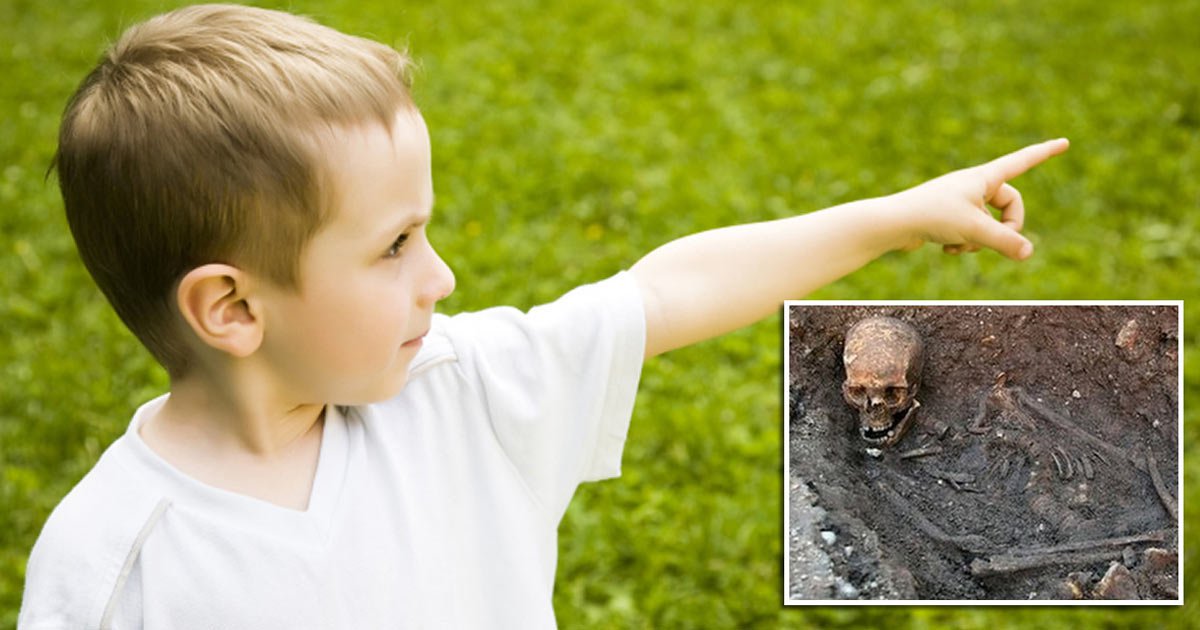
In contemporary research, Dr. Jim Tucker of the University of Virginia has become a leading investigator of reincarnation-like cases. His studies, published in Explore, describe a pattern long familiar to Indian thought: children, not adults, spontaneously recalling past-life experiences. Most begin speaking of a previous existence around the age of 35 months, offering detailed accounts of events, relationships, and places they have never encountered in their present life.
These children often display deep emotional intensity when recounting such memories — crying, longing, or insisting on returning to what they describe as their “former home.” Tucker observes that these recollections typically fade by the age of six or seven, precisely when the child’s awareness becomes more firmly rooted in the present embodiment. Indian psychology would say that as saṃskāras of the current life strengthen, the residual impressions of the previous birth naturally recede.
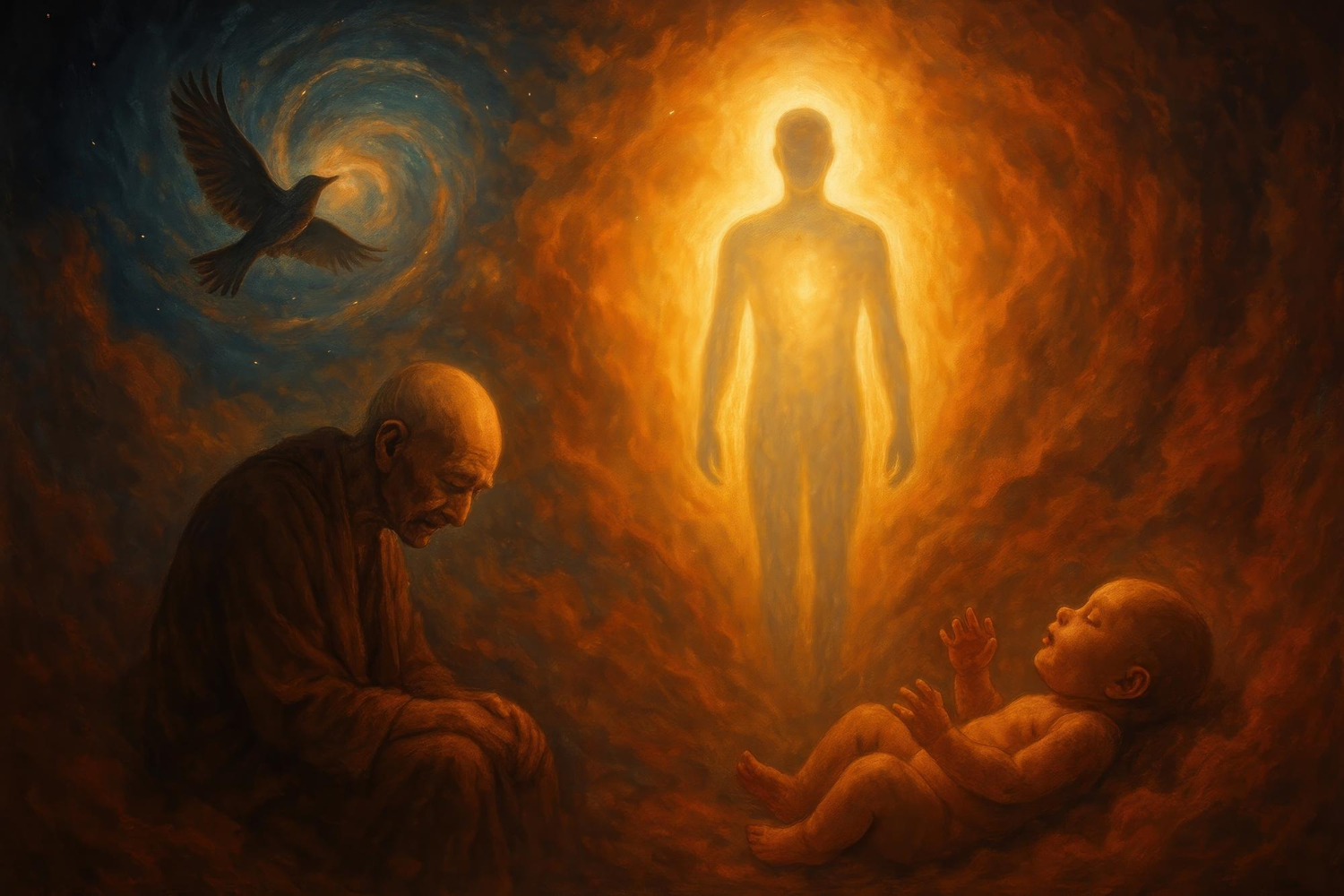
Across cultures and centuries, such cases continue to arise, quietly affirming what the Indian tradition has long held: that consciousness is not extinguished with the body, and that the journey of the jīva unfolds across many lifetimes, guided by memory, impression, and the deeper logic of karma.